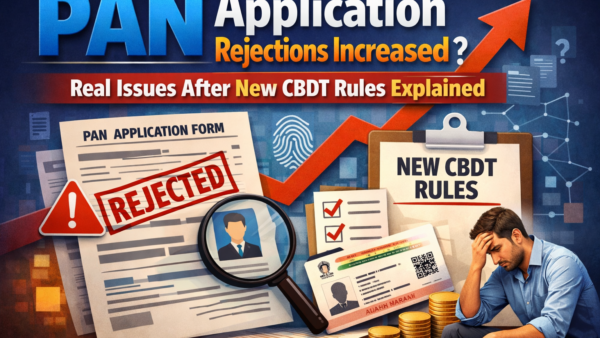

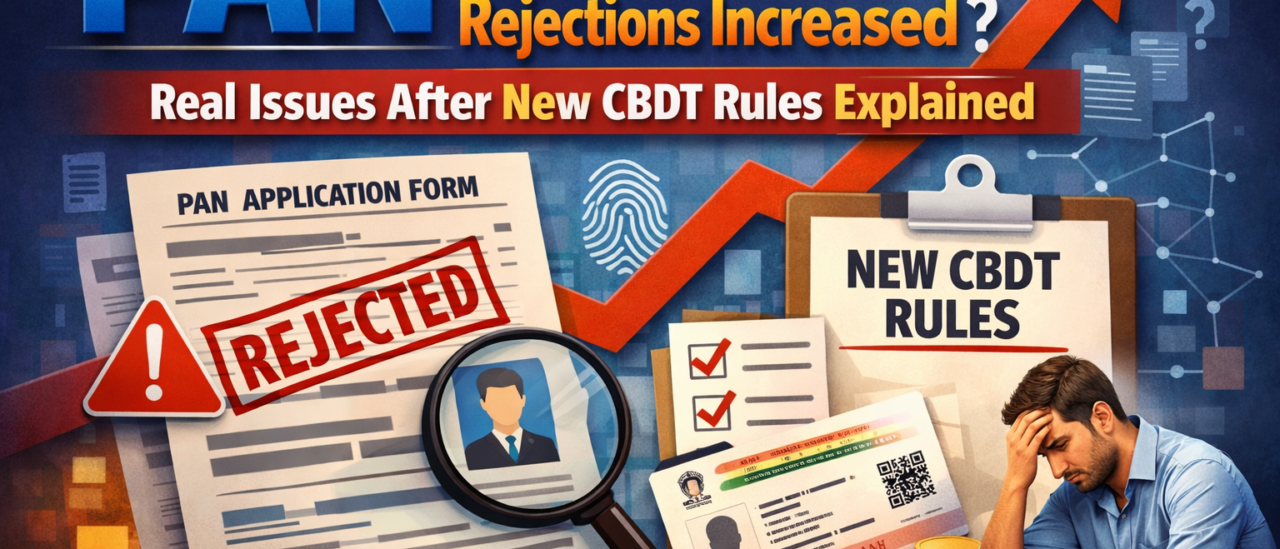
A lot of people feel that PAN applications are getting rejected more often now. That concern is understandable. From April 1, 2026, the new Income-tax Act, 2025 and Income-tax Rules, 2026 came into force, and PAN application forms shifted from the old Form 49A/49AA structure to Forms 93, 94, 95, and 96. The official PAN guidance also says that incomplete applications are treated as invalid, and once a PAN application is finally submitted, it cannot be edited; later fixes must be made through a separate correction process.
Here is the key point: I did not find an official CBDT publication in the reviewed sources that publishes a nationwide number proving that PAN rejections have surged. What the official material clearly shows is that the process is now more structured, more document-driven, and less forgiving of missing or mismatched details. So, even if the rejection rate is not officially published, applicants can still experience more invalidations, more defect flags, and more correction requests because the compliance checks are tighter.
What changed in PAN rules from April 1, 2026
The biggest official change is the transition to the new legal framework. The Income-tax Rules, 2026 came into force on April 1, 2026, and PAN application forms were renumbered. Under the transition FAQs published by the Income Tax Department, the mapping is clear: Form 49A became Form 93 for Indian individuals, Form 94 for Indian non-individual entities, Form 95 for foreign individuals, and Form 96 for foreign entities.
That sounds like a paperwork change, but it matters in practice. The official FAQs also say PAN applications must be supported by the prescribed documents and that incomplete applications are treated as invalid. On top of that, the FAQs say edits are not allowed after final submission. That means a mistake that earlier might have felt easy to correct before processing can now push the applicant into a fresh correction or reapplication cycle.
In plain language, the new system is not necessarily trying to reject more people. It is trying to create cleaner data. But whenever a system becomes more structured, errors that were once overlooked often get caught earlier. That is why many applicants feel rejections have increased.
Are PAN rejections really increasing or just getting noticed more
Officially, the reviewed CBDT and Income Tax Department material does not provide a public national chart showing that PAN rejection rates have jumped after April 1, 2026. The official documents mainly explain the new forms, required documents, and correction workflows.
So the fair answer is this: there is no official public rejection-rate figure in the sources reviewed proving a spike. But there is strong evidence that the process now has clearer form separation, mandatory document support, invalidation of incomplete applications, and dedicated correction forms. Those changes can absolutely make applicants experience more rejections, especially when they choose the wrong form, upload weak documents, or submit data that does not line up across records.
That distinction matters. Saying “CBDT has published evidence of rising rejections” would go too far. Saying “the new rules create more opportunities for applications to be flagged invalid if details are incomplete or inconsistent” is well supported by the official guidance.
The biggest real issues causing PAN application rejection now
1) Incomplete application details
This is the most direct issue. The Income Tax Department’s PAN FAQs state that incomplete applications are treated as invalid. That means blank mandatory fields, partial address details, missing proof uploads, or incomplete representative details can stop the application before it goes far.
2) Missing or wrong supporting documents
Under the official PAN FAQs for the 2026 rules, PAN applications require supporting documents such as proof of identity, proof of address, and proof of date of birth or date of incorporation, depending on the applicant type. For non-individual Indian entities using Form 94, the FAQ also mentions proof of date of incorporation and, for HUF cases, an affidavit for details of members.
This matters because the new framework is form-specific. A citizen individual, a company, an LLP, an HUF, and a foreign applicant are not all being processed through a single broad route anymore. The more specific the form, the more important it becomes to submit the exact supporting papers that match that category.
3) Name mismatch with Aadhaar or other official records
The official PAN correction instructions from Protean say names should not be entered casually. They specify, for example, that titles should not be used, abbreviations should not be used in certain name fields, and where Aadhaar contains initials, expanded names and Aadhaar name handling must follow the stated format. That kind of guidance shows how sensitive PAN processing is to name consistency.
In real life, this becomes a common pain point. A missing middle name, an initial in one document and full name in another, or a father’s or mother’s name entered inconsistently can all create friction. The system is built to match identity data, not guess what the applicant meant.
4) Address mismatch or unsupported communication address
The PAN FAQ for Form 94 says that if the communication address is different from the office address, the applicant must additionally submit proof of that communication address. That tells us the department is looking not only at whether an address exists, but whether the chosen address is supported properly.
The lesson is simple: if you use a correspondence address that differs from your base address, do not assume the system will accept it automatically. Support it with the proper address proof.
5) Applying for another PAN when one already exists
The Income Tax Department’s PAN page states that a person cannot hold more than one PAN. If a PAN has already been allotted, the person should not apply for a fresh one and should surrender the extra one if multiple PANs exist. The page also mentions a penalty under the older Act framework for holding more than one PAN.
So one hidden reason for rejection or trouble is simple duplication. Sometimes applicants think, “My old PAN card is lost,” or “I want corrected details,” and mistakenly apply for a new PAN instead of a correction or reprint. That creates avoidable problems.
How new CBDT correction rules changed the follow-up process
Another major change is that CBDT has now specified dedicated correction forms. An official Income Tax Department order dated April 1, 2026 introduced PAN CR-01 for individuals and PAN CR-02 for non-individuals for changes or correction in PAN data.
That is important because it separates three different situations:
- New PAN application
- Correction in existing PAN data
- Reprint or related follow-up for an existing PAN
When people use the wrong route, they often run into delays or rejection-like outcomes. For example, an applicant with an existing PAN who really needs a correction should not casually start a brand-new PAN application. Under the updated process, the correction pathway is more clearly defined.
The official FAQs also say that once a PAN application is finally submitted, edits are not allowed and corrections must be handled separately after allotment. That makes pre-submission review more important than ever.
Documents required under Rule 158 and why they matter more now
The PAN FAQ document tied to the 2026 rules says the required supporting documents for PAN application under Rule 158 include:
- proof of identity
- proof of address
- proof of date of birth or incorporation
For non-individual Indian entities using Form 94, the FAQ adds proof of date of incorporation and, for HUF cases, an affidavit for details of members. Where an authorized representative or representative assessee applies on behalf of the applicant, the official FAQ says documents of the representative, including proof of identity and proof of address, are also required in addition to the applicant’s documents.
Why does this feel stricter now? Because each form category is more precise, and the document checklist is easier for the system to test against the declared applicant type. A company, trust, HUF, foreign individual, and Indian individual do not all look the same on paper. If the chosen form and the uploaded records do not belong together, the application can quickly turn defective.
Common mistakes that look small but trigger rejection fast
Small mistakes often cause big trouble. Here are the most common ones:
Typing errors in names. Even one missing surname or an extra initial can create a mismatch. Protean’s published instructions show just how specifically names must be entered.
Wrong applicant category. Indian citizens should use Form 93, Indian non-individual entities Form 94, foreign individuals Form 95, and foreign entities Form 96. Choosing the wrong form is not a cosmetic mistake; it changes the supporting document logic.
Weak address support. If you declare a communication address different from the main address, you may need separate proof for it.
Trying to fix an existing PAN through a new application. That can backfire when a correction form is the right tool.
Submitting incomplete information and assuming you can edit later. The official FAQ says you cannot edit the PAN application after final submission.
Step-by-step fix if your PAN application is rejected or marked invalid
First, identify whether the issue is a new application defect or a correction need for an already allotted PAN. That difference is everything. The Income Tax Department separately recognizes correction workflows, and CBDT has specified PAN CR-01 and PAN CR-02 for corrections.
Second, match your case to the right form category:
- Form 93: Indian individual
- Form 94: Indian non-individual entity
- Form 95: foreign individual
- Form 96: foreign entity
Third, re-check your documents in the same order the rules expect: identity, address, and birth/incorporation proof. If a representative is applying, include that person’s required proof as well.
Fourth, review names exactly as they appear in core identity records. Do not improvise titles, short forms, or alternate spellings unless the official instructions allow them.
Fifth, use the official PAN help pages rather than relying only on hearsay. The Income Tax Department’s PAN portal and FAQs are the best starting points.
Practical tips to avoid PAN rejection the first time
Use the correct form first. That one step prevents a lot of headaches. Under the 2026 framework, form selection is no longer something to treat casually.
Type your name exactly as supported by your identity records. The official correction guidance makes it clear that formatting matters.
Keep your document set consistent. If your current communication address is different, support it with separate proof where required.
Do a final review before submission. The official FAQ states that after final submission, editing is not allowed.
Do not apply for a fresh PAN if you already have one. Use the correction or reprint route instead.