
Beyond Individuals: Understanding the New Form 94 for Indian Entities (2026)
While most recent news has focused on personal PAN applications, the Income Tax Rules, 2026 have also introduced significant updates for businesses and organizations. If you are managing a company, partnership, or trust in India, Form 94 is your new essential document for PAN allotment.
Here is a guide to navigating this new corporate and institutional application.
What is Form 94?
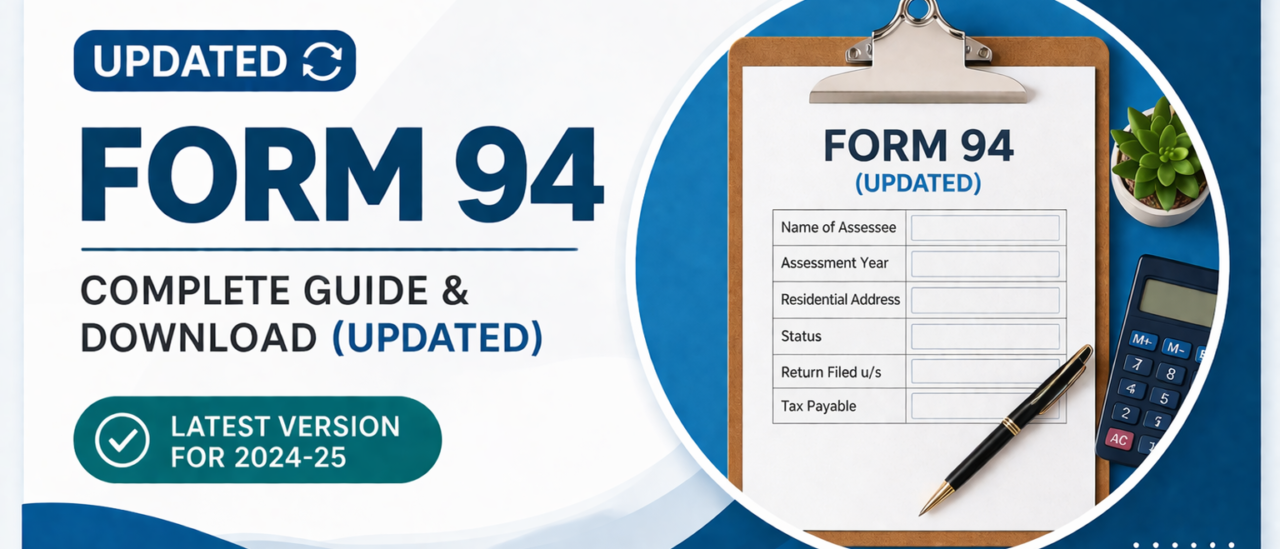
Form 94 is specifically designed for the allotment of a Permanent Account Number to entities incorporated or formed within India. This form replaces older versions for non-individual applicants.
Who Should Apply Using Form 94?
This form serves as the standard application for a diverse range of legal statuses, including:
- Indian Companies
- Partnership Firms and Limited Liability Partnerships (LLP)
- Hindu Undivided Families (HUF)
- Trusts
- Associations of Persons (AOP) and Bodies of Individuals (BOI), whether incorporated or not
- Local Authorities and Artificial Juridical Persons
- Government Entities
Key Sections of the Form
Form 94 is divided into clear parts to ensure all entity data is captured accurately:
- Part A – Personal Information: This covers the legal name of the entity, date of incorporation or agreement, and both the registered office and communication addresses.
- Part B – Source of Income: Entities must disclose their primary revenue streams, such as Business/Profession, House Property, Capital Gains, or Other Sources.
- Part C – Assessing Officer (AO Code): Similar to individual forms, you must provide the Area Code, AO Type, Range Code, and AO Number.
- Part D – Representative Assessee (RA): If the application is filed by an authorized representative, their full name, address, and contact details must be included here.
Mandatory Documentation
To successfully submit Form 94, the entity must provide three core types of proof:
- Proof of Identity
- Proof of Address
- Proof of Formation: This includes documents like the Certificate of Incorporation, Partnership Deed, Trust Deed, or the formal Agreement that created the entity.
If a Representative Assessee (RA) or Authorized Representative (AR) is filing on behalf of the applicant, they must also submit their own Proof of Identity and Proof of Address.
Important Declarations
The form concludes with a strict verification process. The applicant (or their representative) must declare that the entity does not already possess a PAN. Under the Income-tax Act, 2025, providing incorrect information in this declaration can lead to significant legal consequences.